January 22nd:
Tonight was amazing. Bright aurora that you could see color in everywhere for several hours.

Is what I put on Facebook. We’ve been fairly busy and I’ve had other things to worry about so I’ve been bad about the blogging. That night we went out on deck after leaving Tromsø and there was a wonderful display. The lights stretched across most of the sky and one band was running North to South which is unusual. It was bright enough that you could see the green without the camera although it is not as bright and saturated as the camera sees. In another band you could see the rays shimmering and moving and it’s easy to see how people might have thought it was the souls of the dead walking to their afterlife. Unfortunately, it was cloudy below where the main display was so we mostly got a diffuse green glow there and the camera has clouds silhouetting the light and being lit from behind. After a while, I couldn’t say how long, I got cold enough that I came inside and copied my pictures onto the computer and as I was going through them I had a group of Germans come and watch over my shoulder and then later an English couple who asked me to send them one of the pictures. Then I looked up, out the observation deck window and saw a big green loop and threw my gloves and hat back on and ran back outside for part two.

The second bright display was equally dramatic and had more distinct features and movement, though none of it was overhead. It did have a large fan of lines which curved toward the ship which made a nice perspective view. After a while the display dwindled and the clouds moved in more and that was it for the evening. I’ve uploaded all of my pictures of the evening to http://thwartedagain.com/zenphoto/norway/Norway/ as per usual and I’m pretty happy with them. The camera settings I was using to get the bulk of them were 7″, f/2.8, ISO 2000. It was bright enough that I could drop the ISO a bit and the sea was calm enough to allow a longer exposure to make up for it. The stars still mostly have little movement trails but it’s not too bad and there is good detail and color in the aurora.
We have been very fortunate to see a display as good as this with the Earth and Solar weather being what they’ve been.
————————————————————————
January 24th:
We had a snow day today too.
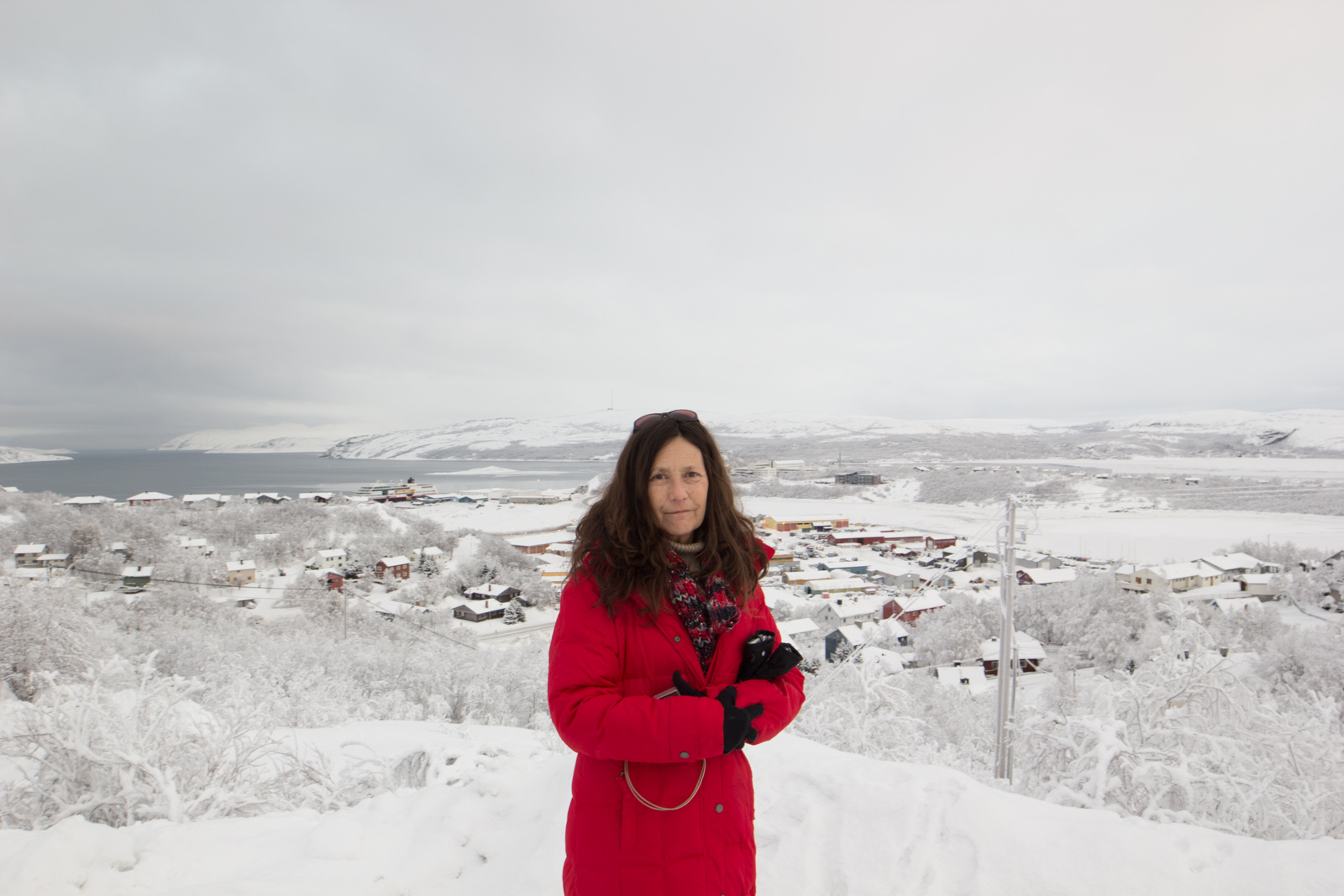
While our friends and family back in Texas are having Snowpocalypse 2014, that being some freezing and a frosting of snow and ice, we spend the afternoon visiting Kirkenes (pron. Tchirknes) and the Snowhotel. The rooms of the Snowhotel are rebuilt every year. They melt enough to become uninhabitable in early spring and are gone shortly after. They make them by inflating “balloons” which are like bounce houses that are the room and hall shapes and then covering them with snow. After a few days the snow is packed and stable enough to deflate the forms. After that a team of Chinese artists come and make carvings in the walls, a different one for each room, and then the ice sculptures are moved in. There are also some non-snow Swiss cabins that are brought to the location for those who require a warmer night’s sleep. The beds and seats have closed cell foam and blankets and you sleep in a big down sleeping bag. The dining tables in the common room are giant slabs of carved ice and apparently the bar serves drinks in ice glasses although it wasn’t open when we were there.

There were high but heavy looking clouds the whole time and the sky was almost the same color as the snow covered landscape. It was pretty but kind of desolate.
Kirkenes is the turning point of the voyage and from there we started sailing back to Bergen.
————————————————————————
January 25th/26th:
We visited a lot of little ports on the 25th very briefly and then stopped in Tromsø at 11:45. Mom and I had signed up for the Arctic Cathedral midnight choral performance so we got off the ship, onto a tour bus and they drove us over the bridge to the cathedral. A lot of the churches and other buildings in Norway were rebuilt after the second world war because as the Russians drove back the German occupying forces the cities were burned to the ground to slow the advance. In a few places some buildings survived but a great many things are new and, as a result, have a modern feel to them. The Arctic Cathedral is very modern looking and is also very beautiful. It is essentially a series of nested triangular prisms with the doors and pipe organ on one end and an entire wall of stained glass on the end behind the altar. We have visited several churches that share this general design but it seems like this is this best example.

I was expecting something like a typical church choir, a few people in each of the usual vocal roles and maybe some organ music to accompany them. What we got instead was one man who played the organ and later a piano, a cellist and a single soprano. It was excellent. The church has a great sound and the singer was superb. She could make herself barely heard or fill the entire space and every sound was perfect. The instrumental accompaniment was equally good. I would have paid good money for a recording, knowing full well that my home stereo could not reproduce the magicial sound but strangely there was no recording on offer. It’s a shame really. We did get program with the performers names so hopefully I’ll be able to find out more about them and maybe even find something they have recorded.
Sadly aurora watching has been mostly a bust. There was a little green splotch hidden by bunch of clouds the night before. That night there was little to see as well. The clouds have been chasing us from Kirkenes.
————————————————————————
January 26th:
This evening we stopped in Svolvær and rather than eating dinner on the boat my mother dragged me out into town and made me try to order a pizza in Norsk. Our blonde pixie waitress greeted us and probably said something about what would we like or “your hat looks stupid” or something and I stammered “Jeg forstår bare lit Norsk” and was starting on “Snakker du Engelsk?” when she asked if I’d rather speak English.
So we got a pizza with pepperoni, pineapple (most of the pizzas had pineapple a.k.a. “ananas”), red bell pepper and some kind of ground meat. I got a Coca-Cola and mom got et glass øl.
So now we’ve indulged our Americanness and tomorrow it’s back to fish and reindeer stew and bowls full of berries covered in whipped cream. That last being not anything particularly Norwegian but rather what constitutes about half of lunch for mom.
Our stop tonight was in Svolvær again. We had previously gone on a walk with Inger and she had pointed out that most restaurants are closed on Sundays or have limited fare which had caused her trouble with a tour group in years past there. However, she continued, “Viva Italia” had a broad menu including Kebab, Pizza, Salads and other things. Mom had decided that instead of eating dinner on the ship we should go into town and find a restaurant to eat in, seemingly having forgotten the part about nothing being open. But we talked to Inger and remembered her story so we walked to Viva Italia. I was, of course, dreading having to try to order dinner for the two of us in a language in which I have a roughly 60 word vocabulary and have never tried on another human being, only responding when prompted by the audiobook playing on the car stereo while commuting to work in the mornings.
We walked into the restaurant and a tiny blonde woman, probably only 25 years old, if that, greeted us and took us to a table and then said a bunch of Norwegian things that I didn’t understand at all. I mustered all of my 16 lessons of Pimsleur Norwegian and informed her in broken, almost unintelligible Norwegian that I understood very little Norwegian and I was working on asking her if she spoke English but she got there ahead of me. So we ordered in English and she asked where we were from and we told her. She, it turns out, is not Norwegian either but rather Polish which means that she actually speaks at least three languages and I imagine probably more. Meeting people like that makes me feel completely useless but I suppose there’s nothing to be done aside from maybe try to learn more language.
Oddly enough, most of the pizzas had “ananas” a.k.a. pineapple. We got a large with pepperoni, pineapple, red bell pepper and some kind of ground meat. It was actually pretty good. They cut the pizza into squares rather than pie slices which was a little odd. Mom had the ubiquitous “Arctic” lager and I had a Coca-Cola. A little taste of home in the dark and cold.
Up on deck that evening we saw a few faint auroral arcs and one bright blob just on the horizon and then that was it. The sky was perfectly clear but there was a strong wind blowing from the west which meant rough seas and the ship was rolling and rocking which doesn’t do wonders for me and makes it basically impossible to take decent pictures. I watched the sky off and on until a little after midnight and then gave up and went to bed. That’s probably the end of the aurora for me for a good long while. It has been beautiful and awe-inspiring and I will miss it greatly. I could see coming back here for lights again or even in the summar since Norway, for all of its expense is welcoming and I’ve had fun. But I also would like to go to Iceland or Canada or Alaska and see the lights again there too. Canada would be exceptionally cold but supposedly north-eastern Iceland is a great place to see the lights and it stays reasonably warm even in the middle of winter because of its position in the gulf stream. Plus there’s lots of natural beauty there as well.