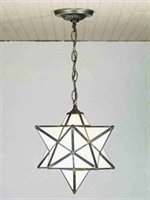
 A while back I received a very nice pendant light for my entry way from my mother. The catalog at Lighting Universe calls it a moravian star though I’m not sure that’s technically correct based on looking at the google results for that term. It is however a fairly specific mathematical solid called a Small Stellated Dodecahedron. A regular dodecahedron has 12 sides each of which is a regular pentagon. If you imagine each of the sides as being part of a plane and then extend that plane outwards and look to see where they all intersect one of the sets of intersections makes this small stellated dodecahedron. It’s a nice looking solid and it has some fun mathematical properties, not the least of which is that the angle between any two adjacent faces is the same. This becomes important later.
 I decided that I wanted to try to make one of these. There’s an ultimate motive behind this but that particular project is so far down the priority list that it might as well be in my will. One star made out of wood is an achievable, short term kind of project. I bought a few pieces of pre-dimensioned pine and some 1/2″ MDF for making jigs and got to work. The first step was to cut 60 triangles out of the pine. I ended up cutting more like 80 due to a few errors early on and so I would have a few extras to practice on. That was fairly easy. Put a gap block on the table slotted into one of the guide grooves to get a constant gap, set the miter gauge on the slide to 18° to get the right angle on the triangles (36°, 72°, 72° isosceles) and then flip the board after each pass.
 The next part is a little more difficult. Once you have your triangles you need to bevel the edges so they will fit together correctly to make the points of the star. If you use the math from the mathworld page you get an angle between planes of 116.57°. That means the bevel angle needs to be half that or 58.3°. The table saw is not really set up for sub degree precision on cuts but you can get there with, again, some trial and error. It is also helpful to have a few jigs to stick the piece in because that means you keep your soft, meaty fingers away from the hungry saw and, depending on how you build the jig, you can cut more than one bevel at a time. Once I got the jigs made, tested and refined it ended up taking about four hours to cut the three bevels per piece. Once they’re all cut they look like this.
After all of the pieces are ready I started gluing them. The way I found easiest was to glue two triangles together and let that dry instead of trying to put all five per point together at once. When you have two sets of two and one single it’s easier to make the pyramidal point. After I’d made all 12 pyramids I glued three at a time into a quarter of the structure. Then finally glued the four quarters into the final star. The gallery of pictures is here and I’ve put a few more thumbnails below. I think it turned out ok and I gave it to a friend who liked it. Now I need to finally get my ass in gear on my book shelves. Wish me luck.


Leave a Reply
You must be logged in to post a comment.