Haruki Murakami is the author of one of my favorite books, Hardboiled Wonderland and the End of the World. The name is a little strange but judging a book by it’s title is not really any more useful than using the cover. The story takes place in two different settings, chapters alternating until the story converges at the end. One of the parts (the End of the World) is inspiration for the setting of Haibane Renmei which I believe qualifies as my favorite anime. At some point I will probably write a little about what it is that I like about Haibane Renmei but for now I’ll leave it be.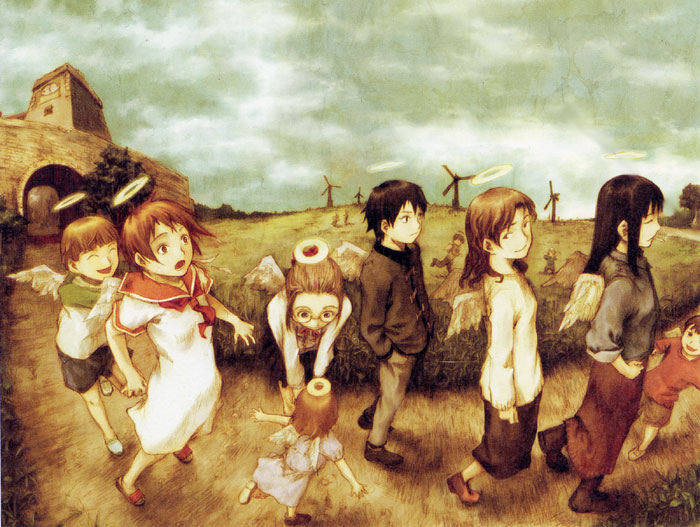 The book is about a person who works as what amounts to human encryption. He reads information, processes it in his head via special training he has received and then transcribes the encrypted form. This part of the story is the Hardboiled Wonderland. There is espionage and thuggery and wanton destruction of private property and romance and a great deal of eating. The other half of the story is about a dream-like place which is the End of the World. It is in a town and local farmland and forest landscape surrounded by a high, seamless wall. The unnamed protagonist of this part of the story is separated from his shadow at the beginning of this part and is sent to “read” old memories from the bleached skulls of the local cow analogue which are stored in the library. Only he can do this because he is not yet wholly part of the town. During the course of the book connections begin to appear between the two parts of the story and eventually we come to understand how the two parts relate and what is happening to the protagonist. There is a very liminal quality to both parts of the book. The Hardboiled Wonderland part ultimately becomes the story of the last days of the main character, how they came to be his last and what he decides to do with them. The End of the World part also has a defined separation between the main character and the world he is in and a count down to when he will lose his individuality and become part of the town inside the wall. It’s pretty good. Murakami has a way with conversation that I like and he is very meticulous about the detail of his settings and the minor actions his characters take. It gives them personality beyond the things that they say.
 Murakami’s After Dark was published in the U.S. this year and I picked it up last weekend and read it. It takes place in Tokyo between midnight and dawn. The thing that got me to buy it was that my friend Aaron recently went to Japan and one of the stories he brought back was of a night he spent in Tokyo. The subways stop running around midnight and don’t start up again until 5:30 or 6:00 in the morning so if you miss the last train it’s either a prohibitively expensive cab ride home or you’re out for the night. The idea appeals to me. Specifically it reminds me of one night from my freshman year in college among the many sleepless or almost sleepless nights. My roommate frequently had “guests” over which interfered with my sleep and ultimately drove me to spend as much evening time away from my room as possible. I started frequenting the Metro coffee shop on the drag and that is where I met a large number of my college friends. One weekend the roommate had two friends visit and I volunteered my bunk for one of them as I didn’t really want to be there when they all came back from their downtown escapades and I was used to being out late anyway. What’s a few more hours until the sun rises?
So the idea of willingly stranding yourself in your own town for a night resonates. The book mainly focuses on Mari Asai who is a 19 year old college student we find sitting in the second floor of a Denny’s reading a book, drinking coffee she doesn’t seem to particularly enjoy and occasionally lighting a cigarette but not really smoking much of it. A trombone bearing young man enters the restaurant notices her and sits down and the story goes from there. There are a couple of subplots about Mari’s sister Eri who has been asleep for two months and a salaryman working late who has problems mostly of his own manufacture. In all three of Murakami’s books which I have read the boundaries between the real world and other, stranger dreamworlds seem thin. His characters are either thrust into or seek out situations or places where the boundaries are at their thinnest and they end up going through. I guess a lot of the books I like have similar themes. Neil Gaiman writes books with permeable reality like Neverwhere and Stardust and his Sandman comic is basically about the soft border between the waking world and the Dream. One of the neat things in After Dark is that the normal Tokyo restaurants, streets, parks etc. seem as surreal as the strange place the sleeping Eri goes during her part of the story or the End of the World as if the night itself is a strange otherland and the last train carries the city of the day with it out to the suburban neighborhoods only to return with the dawn. It’s pretty quality and a short read though I think I’d wait for paperback though as twenty bucks is a bit steep for 180 pages.
Now I’m trying to chip away at Vineland by Thomas Pynchon and I’m having less luck than I would like. The writing style is dense and a lot of the grammar is confusing. The descriptions take on a very stream of consciousness style in places that is nigh-impenetrable and makes it hard to get into the story. I’m going to keep at it though because I suspect there’s something cool going on that I’ve only seen the tip of so far.
Leave a Reply
You must be logged in to post a comment.